What Is UGC? A Simple Guide for Brands
What UGC means, the two kinds brands use, why it works, where to get it and the rules to follow, explained in plain English for online brands.
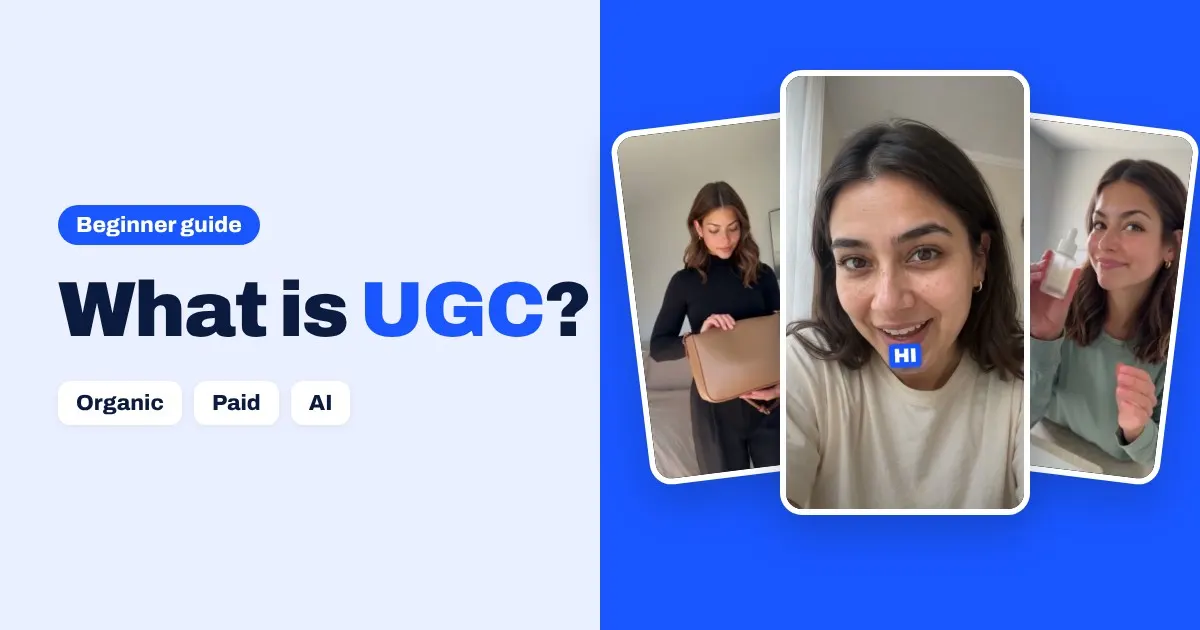
UGC stands for user-generated content. In the simplest terms, it's content made by people rather than by the brand: a customer's review video, an unboxing on TikTok, a photo of your product on someone's kitchen counter.
You'll also hear "UGC" used for something slightly different: videos that brands pay creators to make in that same real, person-to-camera style, then run as ads. Both are called UGC, and mixing them up causes a lot of confusion. This guide explains both, why they work, where to get them and the rules you need to follow.
The two kinds of UGC
1. Organic UGC from customers
This is the original meaning. A customer posts about your product because they want to, without being paid. The Interactive Advertising Bureau (IAB) describes it as content that may or may not mention a brand, where there's "no material connection" between the brand and the person who posted it (IAB).
Examples:
- A customer's TikTok showing how they use your product
- A photo review on your website
- A tagged Instagram story
- A YouTube unboxing
2. Paid UGC from creators
This is what most marketers mean today when they say "UGC ads". A brand hires a creator to make a video that looks and feels like a real customer post, then runs it as an ad from the brand's own page. The creator doesn't need followers. They're paid for the video, not for their audience.
There's also AI UGC, where the creator in the video is made with AI. It's made in the same style and used the same way, mainly for testing ads quickly. We compare it with human creators in AI UGC vs real creators.
| Organic UGC | Paid UGC | |
|---|---|---|
| Who makes it | Real customers | Hired creators, or AI |
| Paid? | No | Yes |
| Can you plan it? | No | Yes, with a brief |
| Main use | Social proof, reviews | Ads on Meta and TikTok |
| Permission needed | Yes, before you reuse it | Agreed in the deal |
Common types of UGC
Whether it's organic or paid, most UGC falls into a few formats:
- Reviews and testimonials. Someone talks about their experience with the product.
- Unboxings. Opening the package and first reactions.
- Demos and how-tos. Showing the product in use, step by step.
- Before and after. The problem, then the result. Check the platform rules first for health and beauty products.
- Day in the life. The product shown naturally as part of someone's routine.
- Problem and fix. A relatable problem, then the product as the answer.
- Comparisons. The product next to the old way of doing things.
Why UGC works
It feels like a recommendation, not an ad
People trust other people more than they trust brands. In surveys cited by EMARKETER, 60% of consumers called UGC the most genuine form of advertising, and 70% of Gen Z said it's very helpful when deciding what to buy (EMARKETER). Older research collected by the IAB points the same way: in a 2017 Stackla survey, 60% of people said content from friends or family influences what they buy, compared with 23% for content from celebrities (IAB).
It fits the feed
On TikTok and Reels, polished brand ads stand out as ads. UGC looks like everything else people are scrolling through, so they're more likely to stop and watch. The platforms encourage this. TikTok's creative advice includes shooting vertically and getting your message across in the first few seconds, the way a creator would (TikTok).
It's cheaper to test
Paid UGC costs far less than a traditional ad shoot, so you can make several versions and test them. That matters, because the first ad is rarely the winner. We cover this in how many ad creatives to test.
Where to get UGC
Your own customers
Ask happy customers to share a video or photo, for example in a follow-up email after delivery. Some brands offer a small discount for a review with a photo or video. Make it easy: tell them exactly what to film and how to send it.
UGC creators
You can find creators on UGC marketplaces, through agencies or by contacting them directly. Expect to pay roughly $150 to $300 per video for a mid-level creator, plus extra if you want to run it as an ad. We break down the numbers in how much a UGC video costs. To get good results, send a clear brief. Our guide to writing a UGC creator brief has a template.
Influencers
Influencers make UGC-style content too, but you're mainly paying for their audience. We explain the difference in UGC vs influencer marketing.
Done-for-you AI UGC
Services like UGC Beast write the script and make the video with AI creators. It's the fastest way to get many versions to test, and there's no product shipping or reshoots.
Want to see what a UGC ad for your product could look like? Send us your product link and we'll make your first one free.
Where to use UGC
- Paid ads on Meta and TikTok. The biggest use. Test several hooks and angles to find a winner.
- Your product pages. Customer photos and videos next to the "Add to cart" button help people decide.
- Your social feeds. Reposting customer content, with permission, shows real people using your product.
- Emails. A customer video in an email feels more personal than a product photo.
- Creator ads. Run a creator's video from their own account with Meta partnership ads or TikTok Spark Ads. See Meta partnership ads and TikTok Spark Ads.
The rules you need to follow
UGC works because it feels honest, so keep it that way.
- Ask before you reuse a customer's post. A customer posting about you doesn't give you the right to use their video in your ads. Get permission in writing, even a reply to a DM saying yes.
- Agree on rights with paid creators. Write down where you can use the video and for how long, especially for paid ads.
- Disclose paid relationships. In the US, the FTC says creators have to clearly disclose a paid or free-product relationship when they post about a brand, and in a video the disclosure should be in the video itself (FTC).
- No fake reviews. The FTC bans fake reviews and testimonials, including ones from people who don't exist (FTC). Don't present a paid or AI video as a genuine customer review, and don't invent results.
- Only make claims you can prove. This matters most for skincare, supplements and anything health related.
How to get started
- Pick one product and one problem it solves.
- Look at what's working in your market. The Meta Ad Library shows your competitors' live ads for free.
- Write a few hooks. Use our list of UGC ad hooks for ideas.
- Get three to five videos made, from customers, creators or AI.
- Test them as ads on a small budget, keep the winners and make more versions of what works.
FAQ
What does UGC stand for?
User-generated content. It means content made by people, like customers or creators, rather than by the brand itself.
Is UGC the same as influencer marketing?
No. With UGC, you're usually paying for the video and running it yourself. With influencer marketing, you're paying for the creator to post to their own followers.
Do I need permission to use customer UGC?
Yes. Ask the person and get their yes in writing before you use their post on your website or in ads.
Is AI UGC still UGC?
It's made in the UGC style and used the same way, as ads, but it isn't from a real customer. Don't present it as a real customer review.
How much does UGC cost?
Organic UGC from customers is free, apart from any discount you offer. Paid creator videos usually cost $150 to $300 each, and AI UGC can cost much less per video.
UGC is one of the simplest ways to make ads people actually watch. If you'd like it done for you, UGC Beast writes the scripts and makes the videos, and your first one is free.