UGC Ad Hooks: 40 Opening Lines That Stop the Scroll
40 UGC ad hooks you can adapt today, the 6 hook types behind them and how to test hooks on Meta and TikTok without wasting your budget.
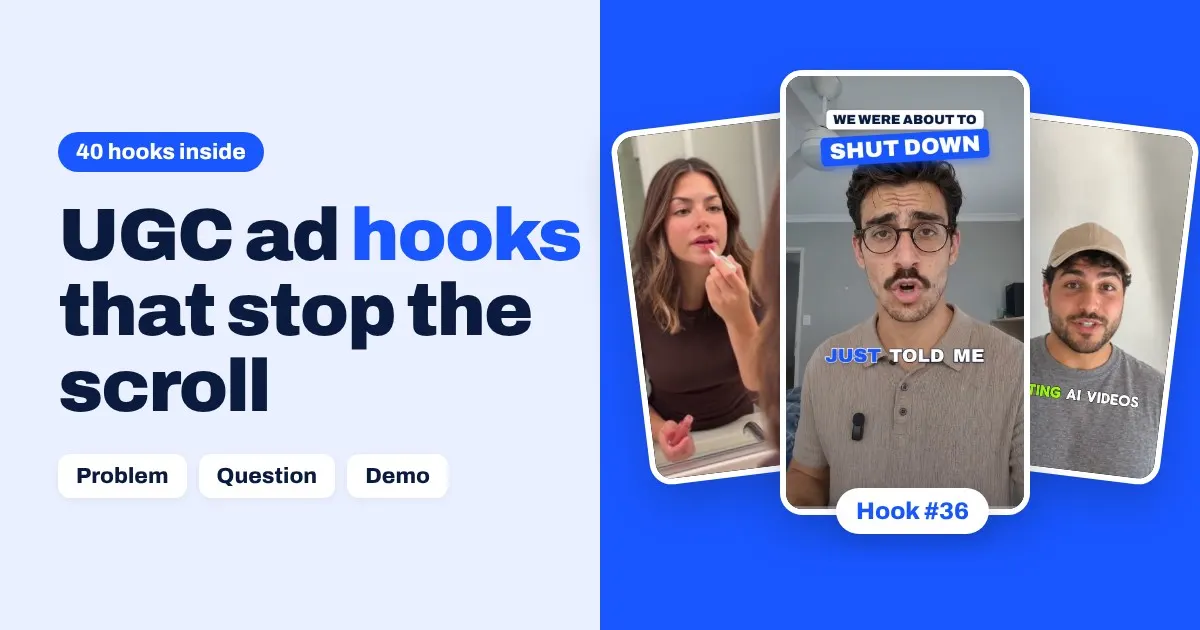
The hook is the first line and the first shot of your ad. It decides whether someone watches your video or scrolls past it. Everything after it, your product, your proof and your offer, only matters if the hook does its job.
This guide gives you 40 hooks you can adapt for your own product, grouped by the six types we use most. You'll also see why the first seconds matter so much, how to match a hook to the rest of your ad and how to test hooks without burning your budget.
Why the first seconds decide everything
People scroll fast. Back in 2017, Facebook said people scroll through their feed 41% faster on a phone than on a computer, and that research it cited found people could recall mobile feed content after seeing it for just 0.25 seconds (Marketing Dive). Your hook has a fraction of a second to make someone stop.
Short views still count. A Nielsen analysis of Facebook video ads found that people who watched for three seconds or less still produced 47% of the ad recall lift and 44% of the purchase intent lift (MarTech). So the opening seconds aren't just a door into the ad. For many viewers, they are the ad.
The platforms say the same thing today:
- TikTok tells advertisers to put the hook in the first 6 seconds and to get the main message across in the first 3 seconds for better recall (TikTok).
- Meta says great Reels nail the hook within the first few seconds, and that small changes to a hook can make a big difference in results (Social Media Today).
- In research Meta shared with Toluna, hooks that worked through both the picture and the sound made an ad 1.5 times more likely to rank in the top 20% for purchase intent (Social Media Today).
That last point is easy to miss. A hook isn't only words. It's what people see, what they hear and what they read on screen, all landing at once.
The 3 parts of a hook
Every strong UGC hook has three layers working together:
- The spoken line. What the creator says in the first sentence.
- The visual. What's happening on screen: the product in hand, a messy before shot, a surprising action.
- The text on screen. A short caption that makes the point even with the sound off.
You don't need all three to say the same thing. The best hooks often split the job. The creator asks a question, the screen shows the problem and the caption names the product. Keep on-screen text short. TikTok suggests about 5 to 10 words per second when you use text (TikTok).
40 UGC ad hooks you can use
Swap the words in brackets for your own product, problem and customer. Every hook has to be true for your product, so skip the ones you can't back up.
Problem hooks
These open with a pain your customer already feels. They work well because people recognise themselves before they see the product.
- "If your [problem] keeps coming back, watch this."
- "I was so tired of [problem] that I almost gave up on [category]."
- "Nobody tells you this about [problem]."
- "This is what [problem] actually looks like after a week."
- "Stop doing this if you have [problem]."
- "My [problem] was so bad I stopped [everyday activity]."
- "Every [type of customer] knows this feeling."
Question hooks
Questions make people answer in their head, and that keeps them watching. Meta lists questions as one of three hook styles worth testing (Social Media Today).
- "Why does nobody talk about [problem]?"
- "Do you still [old way of doing things]?"
- "What if [task] only took [short time]?"
- "Can a [price] [product] really beat a [higher price] one?"
- "Have you ever [relatable moment]?"
- "Is it just me, or is [common frustration] getting worse?"
Bold statement hooks
A strong opinion makes people stop to see if you can back it up. Keep these honest, or the rest of the ad falls apart.
- "This is the only [product] I'll buy now."
- "I was wrong about [category]."
- "You don't need [expensive alternative]. You need this."
- "Unpopular opinion: [common habit] is a waste of money."
- "I'm never going back to [old product]."
- "This replaced three things in my [room or bag]."
- "Most [category] products get this completely wrong."
Demo and result hooks
Show, don't tell. These open on the product doing something people can see straight away.
- "Watch what happens when I [action]."
- "Day 1 vs day 30 with [product]."
- "Here's [product] after [tough test]."
- "I tested [product] so you don't have to."
- "This is how long it takes me to [task] now."
- "Look how [product] handles [common problem]."
- "Before and after. No filter."
Before-and-after hooks need care. If you sell skincare, supplements or anything health related, check the platform rules first. They limit what you can show and claim.
Curiosity hooks
These open a loop the viewer wants closed. The payoff has to come quickly, or people feel tricked and scroll away.
- "I found the [product] everyone on my feed is using."
- "There's a reason this keeps selling out."
- "I didn't expect a [product] to do this."
- "The [product] my friends keep stealing from me."
- "This is the thing nobody mentions about [category]."
- "I finally figured out why [problem] happens."
Social proof and story hooks
People trust other people. These hooks lean on real experiences, reviews or a short personal story.
- "My [family member or friend] made me try this."
- "I bought this because of the reviews. Here's my honest take."
- "We were about to [give up or shut down] until we tried this."
- "The comment that made me try [product]."
- "I've been using this for [time]. Here's what changed."
- "POV: you finally found a [product] that [benefit]."
- "Story time: how [product] saved my [event or day]."
Social proof has to be real. In the US, the FTC's rule bans fake reviews and testimonials, including ones from people who don't exist or who never used the product (FTC). If an AI creator delivers the line, base it on real customer feedback and never invent results.
Want these turned into finished ads? Send us your product link and we'll make your first UGC ad free, with the hook written for your product.
How to pick the right hook for your product
A hook that works for a lip gloss won't always work for a project management app. Three questions help you choose.
What does your customer already know?
- They don't know they have a problem. Use problem or curiosity hooks to name it.
- They know the problem but not your product. Use demo or bold statement hooks to show your answer.
- They know your product but haven't bought. Use social proof hooks to remove the doubt.
Can you show it in the first second?
If your product does something visual, like cleaning, fitting, glowing or folding, a demo hook almost always beats a talking one. If it doesn't, like an app or a service, lead with the problem and show the screen right after.
Does the hook match the rest of the ad?
A hook that promises one thing and an ad that delivers another is the fastest way to lose viewers. If the hook says "the only lip gloss that isn't sticky", the next shot has to prove it's not sticky. Keep the promise and the proof together.
How to test hooks without wasting money
One hook is a guess. The way to find a winner is to test several openings on the same ad.
- Keep the body the same. Make one ad, then record three to five different hooks for it. If the only thing that changes is the opening, you know the hook caused the difference.
- Make the hooks truly different. Five versions of the same question won't teach you much. Test a problem hook against a demo hook against a social proof hook.
- Give each version a fair budget. Let each hook get enough views before you judge it. Turning ads off after a few hours tells you very little.
- Watch the early numbers. Look at how many people watch past the first few seconds, plus clicks and cost per result. A hook that holds attention but gets no clicks may be promising the wrong thing.
- Keep a hook bank. Save every winning hook in a spreadsheet with the angle, the product and the result. Old winners often work again in new ads.
TikTok recommends 3 to 5 different creatives per ad group, and says creatives with big differences work better, especially when you're testing (TikTok). Different hooks on the same ad are the cheapest way to get there. We cover how many ads to run in how many ad creatives to test.
Common hook mistakes
- Starting with a logo or an intro. "Hi guys, today I want to show you..." loses people before you've said anything.
- Being too clever. If people have to think about what the hook means, they've already scrolled.
- Promising what you can't show. Clickbait might get the view, but it kills trust and often breaks ad rules.
- Hiding the product for too long. Meta's research found ads that showed the product more than once were 2.7 times more likely to rank in the top 20% for purchase intent (Social Media Today). Get it on screen early.
- Forgetting the sound-off viewer. Add a caption to every hook so it works even when the sound is off.
FAQ
How long should a UGC ad hook be?
Aim for one short sentence that's said in about two to three seconds. The visual should grab attention from the very first frame.
How many hooks should I test per ad?
Three to five is a good start. Make them different types, not small rewrites of the same line.
Can I copy a competitor's hook?
Learn from the angle, not the wording. Write your own version that's true for your product. Our guide to the Meta Ad Library shows how to find hooks that are working in your market.
Do hooks work the same on Meta and TikTok?
The idea is the same: grab attention fast. TikTok ads tend to feel more casual and creator-led, so hooks that sound like a real person talking usually do better there. Test on both.
Do AI UGC ads need different hooks?
No. The same hooks work. What matters is that the delivery looks and sounds natural. Read more in AI UGC vs real creators.
Pick five hooks from this list, adapt them to your product and test them. If you'd rather have it done for you, UGC Beast writes the hooks, makes the ads and sends them ready to run, and your first video is free.