AI UGC vs Real Creators: Which Ads Actually Sell?
AI UGC is cheaper and faster. Real creators still win on trust. What the research says, what each costs and when to use which for Meta and TikTok.
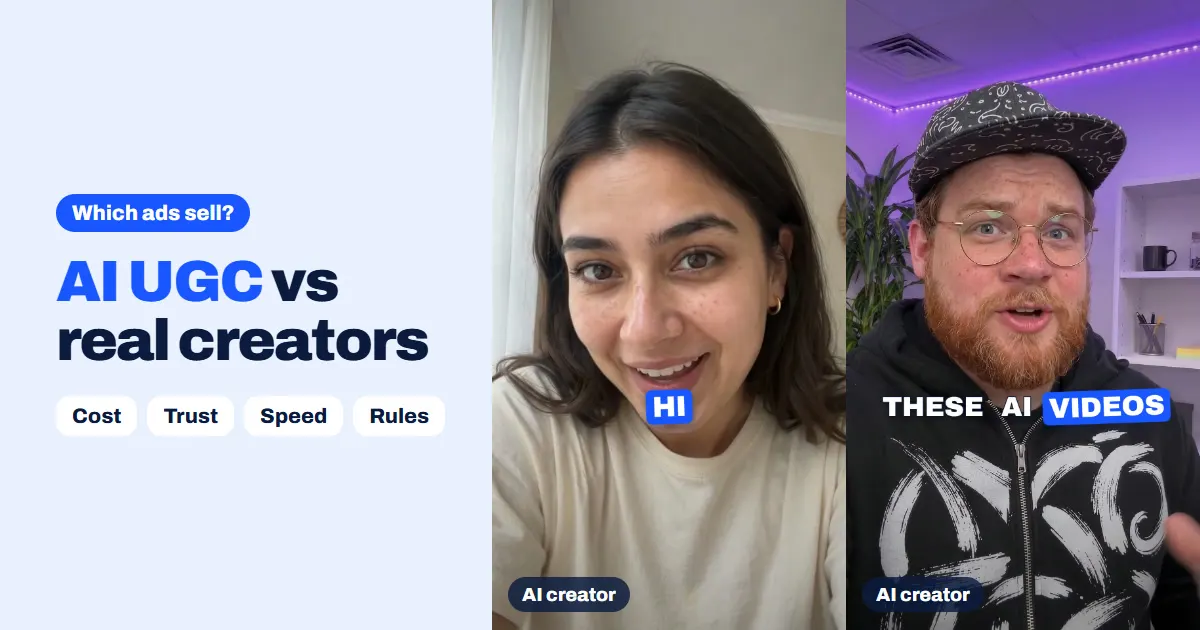
Real creators still win on trust. AI UGC wins on cost, speed and how many ads you can test. In a May 2026 Ipsos study of 20 brand ads, human-made ads scored 14% higher on short-term ad effect than AI ones, but most viewers couldn't reliably tell which ads were AI (Billo).
So the useful question isn't which one is better. It's which one to use for which job. Below is what the research says, what each option costs, and the rules you have to follow if you run AI ads on Meta and TikTok.
What is AI UGC?
AI UGC is a video ad that looks like user-generated content (a person talking to their phone camera about a product), but the person, the voice or the footage is made with AI. There's no creator to hire, no product to ship and no filming day. You start from a script and get a finished video in hours or days instead of weeks.
Real-creator UGC is the classic version. A real person films themselves with your product, and you pay them for the video and for the right to run it as an ad.
AI UGC vs real creators at a glance
| AI UGC | Real creators | |
|---|---|---|
| Cost per video | About $25 to $40 done for you, less if you make it yourself | Usually $150 to $300, plus 25% to 100% for ad usage rights |
| Time to first ad | Hours to a few days | Often 2 weeks or more, including shipping |
| Extra hooks | Cheap to add | Usually 10% to 20% more per hook |
| Product in hand | Needs real product shots for close-ups | Real product in real hands |
| Trust | Good when it's done well | The highest |
| Changes | Edit the script and render again | Reshoots cost extra |
| Rules | Must be disclosed on TikTok, can't pose as a real customer | Normal ad and sponsorship rules |
The creator prices come from our full breakdown of what a UGC video costs, which links every source.
What the research says
There are still very few honest tests of AI ads against human ones. Here are the two worth knowing.
The Ipsos study. Ipsos showed 20 real brand ads (10 made by people, 10 made with AI) to 3,000 US consumers. The human-made ads scored 14% higher on short-term creative effect and 17% higher on long-term brand equity. But in every comparison a large share of people saw no real difference, and only 25% could confidently pick out the AI ads (Billo).
A skincare test on TikTok. A brand tested 12 AI UGC videos with different hooks. The best three reached a 4.2% click-through rate, while the other nine averaged 1.1%. When three real creators then filmed the winning hook, their videos converted 18% better than the AI versions at the same spend. The 12 AI videos cost $6 in total; the real creator shoots cost about $900 (Pose AI). Pose sells an AI UGC tool and the sample is small, so treat this as one example, not proof.
Put the two together and the pattern is clear. Real creators have an edge on trust and conversion when the message is the same. AI's edge is finding the right message cheaply, and the message matters a lot: in the TikTok test, the best hooks got almost four times the clicks of the rest.
Where AI UGC wins
- Cost. You can test 10 ads for less than the price of two creator videos once usage rights are added.
- Speed. No shipping, no scheduling and no waiting for a creator to film.
- Hook testing. The first 2 seconds decide whether people keep watching. AI lets you try five openings on the same ad without paying for five shoots.
- Changes. Want a different line, offer or call to action? Change the script and render again.
- Consistency. The same face, setting and style across a whole set of ads.
Where real creators still win
- Physical proof. Texture, taste, fit, real results over time and real packaging. If the sale depends on seeing the product work in real hands, use real footage.
- Reviews and testimonials. If a video says "I used this for 30 days and here's what happened", it has to be a real person with a real experience. More on that below.
- Their audience. If you want the creator to post on their own account and bring their followers, you need a real creator.
- Sales where trust is everything. When buyers need a lot of reassurance before they spend, the trust edge from the Ipsos study matters more.
The rules you can't skip
AI UGC is allowed on the big ad platforms. You just have to be open about it.
- TikTok: ads with images, video or audio that are completely AI-generated must be disclosed, either with TikTok's AI-generated content label or with your own clear disclaimer, caption, watermark or sticker. If TikTok finds undisclosed AI content, the ad will be rejected or restricted (TikTok ads policy).
- Meta: Meta may add an "AI info" label when it detects AI-generated content in an ad, and ads about social issues, elections or politics have stricter disclosure rules (Meta).
- US law: the FTC's rule on fake reviews bans testimonials that pretend to come from someone who doesn't exist, including AI-generated ones, and reviews from people who never used the product. The FTC can seek civil penalties (FTC).
A simple way to stay safe: an AI creator can present your product, show how it works and explain what it does. Don't have an AI creator claim a personal result they never had.
The playbook: use both
This is the approach that makes sense for most brands, and it's how we'd spend a test budget:
- Write 2 angles with 5 hooks each. That's 10 ads.
- Make them with AI UGC and run them on a small budget. Judge them on click-through rate, how long people watch and cost per purchase.
- Scale the winner. If it keeps selling, keep it as it is.
- Bring in a real creator if trust is the problem. Lots of clicks but weak sales can mean people don't believe it yet. Have a creator remake the winning hook.
- Add new hooks every month. Even winning ads wear out as the same people keep seeing them.
How to make AI UGC that doesn't look fake
- Write like a person talks. Short sentences, casual words, one idea per line. Ad copy read out loud sounds like an ad.
- Use real-looking places. Bedrooms, cars, kitchens and natural light look like real UGC. Studios don't.
- Use real shots of your product for close-ups. AI is good at people. It can still get labels, logos and small text wrong.
- Keep it short. 15 to 45 seconds, captions on, hook in the first 2 seconds.
- Check every frame before it runs. Look at hands, on-screen text and product details.
Want to see how close it gets? Both people in the video on our homepage are AI.
FAQ
Can people tell AI UGC from real UGC?
Often they can't. In the Ipsos study, only 25% of viewers could confidently identify the AI ads, and another 40% weren't sure either way.
Is AI UGC allowed on Meta and TikTok?
Yes. Both platforms allow AI-generated ads as long as they follow the normal ad rules and the disclosure rules above.
Do I have to label AI UGC ads?
On TikTok, yes, if the images, video or audio are completely AI-generated. On Meta, ads may get an "AI info" label automatically, and political or social-issue ads must disclose realistic AI content.
Is AI UGC cheaper than real creators?
Yes, by a lot. Done-for-you AI UGC costs about $25 to $40 per ad. A real creator video usually costs $150 to $300 before usage rights. See our UGC cost breakdown for the details.
Will AI UGC replace real creators?
Not completely. AI is the fastest and cheapest way to find what sells. Real creators are still the strongest option when trust or physical proof decides the sale. Most brands get the best results using both.
If you want to test the AI side first, your first video is free.