How Many Ad Creatives Should You Test on Meta?
How many ads to test on Meta and TikTok, why creative variety matters more than ever, how to spot creative fatigue and a simple testing plan for small budgets.
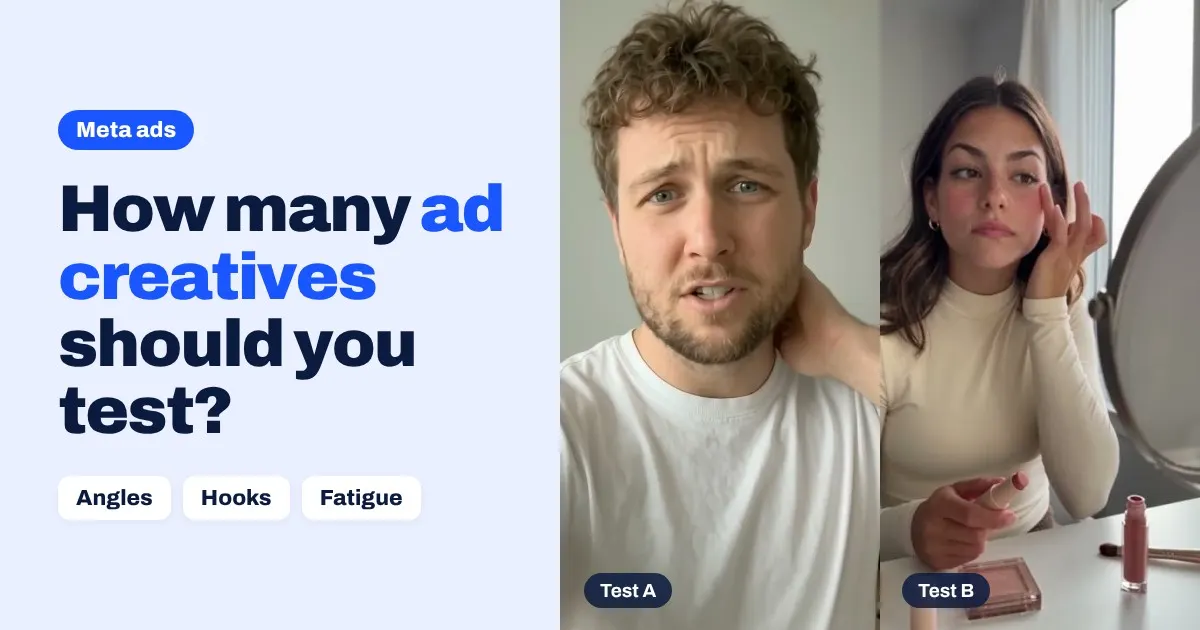
There's no magic number of ads that guarantees results. But there is a clear trend: on Meta and TikTok, the brands that test more different ads find winners faster and keep their costs down longer. Running one or two videos until they die is the most expensive way to advertise.
This guide explains why creative volume matters so much now, how many ads to start with, how to tell when an ad is tired and a simple testing plan you can run on a small budget.
Why creative now does the targeting
A few years ago, the main lever in Meta ads was targeting: picking interests, ages and lookalike audiences. Today, Meta's system does most of that work itself, and your ads give it the signals it needs.
Meta's ad system uses a retrieval engine called Andromeda to narrow tens of millions of possible ads down to a few thousand for each person before ranking them (Engineering at Meta). Meta built it expecting the number of ads in its system to grow a lot, as advertisers make more creatives with AI tools.
In late 2025, Meta told advertisers to treat creative diversification as a foundational best practice: a broad mix of text, image and video ads rather than a fixed number per campaign. Its AI delivery system can test many creatives, so more truly different ads give it more chances to match the right ad to each person (Social Media Today).
Put simply, each different ad you run reaches a slightly different kind of person. One ad might win with busy parents and another with gym-goers, all inside the same broad audience. The more different ads you give Meta, the more people it can find for you.
Different beats more
Twenty ads that look the same count as one ad with small edits. Meta has even added a Creative Diversity column in Ads Manager that rates how varied your images and videos are as Low, Medium or High (Search Engine Land). The column was labelled "in development" when it launched, but the message is clear: variety is what counts.
Here are the levels where ads can be different, from the biggest change to the smallest:
- Angle. The main reason to buy. "It saves time" and "it's cheaper than the alternative" are two different angles.
- Format. A talking-head review, a demo, an unboxing, a get-ready-with-me or a voiceover over B-roll.
- Creator. A different person, age, look or setting changes who the ad speaks to.
- Hook. The first line and first shot. Same body, new opening.
- Small edits. Captions, music, colours or the end card.
Start your tests at the top of this list. A new angle or format teaches you far more than a new caption colour. Hooks sit in the middle: cheap to make and often a big difference. We list 40 of them in our guide to UGC ad hooks.
How many ads to start with
Meta doesn't give an official number, and neither do we. But the platforms do give useful guides:
- TikTok recommends 3 to 5 different creatives per ad group and 3 to 5 ad groups per campaign, and says creatives with big differences are preferred, especially when testing (TikTok).
- Meta has moved away from a fixed number and now talks about diversity instead, as above.
From running ads ourselves, here's a simple starting point based on your monthly budget. Treat it as a rule of thumb, not a law.
| Monthly ad budget | New ads to test each month | How to build them |
|---|---|---|
| Under $1,000 | 6 to 10 | 2 angles, 3 to 5 hooks each |
| $1,000 to $10,000 | 15 to 30 | 3 to 5 angles, several hooks and 2 formats |
| Over $10,000 | 40 or more | New angles, formats and creators every week |
The reason for "per month" is that ads wear out. Testing isn't something you do once. It's a habit.
Need more ads to test? Send us your product link and we'll make your first UGC ad free, then help you build a testing plan.
How to spot creative fatigue
Creative fatigue is when an ad stops working because the same people have seen it too many times. Meta describes it simply: fatigue rises as an audience sees the same creative repeatedly, and it usually shows up as a falling click-through rate and a rising cost per action (Meta for Developers).
Signs to watch for:
- Cost per result keeps climbing for several days in a row while nothing else has changed.
- Click-through rate drops compared with the ad's first week.
- Frequency keeps rising, which means the same people are seeing the ad again and again.
- Ads Manager shows a delivery message about creative fatigue or limited creative in the Delivery column.
High frequency on its own isn't always bad. Some ads keep working even when people have seen them several times. What matters is whether the results are holding up.
TikTok gives similar advice: refresh your creatives when results show a steady decline, and add the new creatives to your existing ad group rather than starting from scratch (TikTok).
A simple testing plan
You don't need a big team or a big budget to test properly. Here's a plan that works for most small brands.
Week 1: Test angles
Make two or three ads, each with a different angle. Keep everything else as similar as you can, like the same creator style and length. Run them together and see which angle gets the cheapest results.
Week 2: Test hooks on the winning angle
Take the angle that won and make three to five versions with different hooks. The body of the ad stays the same. This is usually where costs drop the most.
Week 3: Test formats
Take the winning angle and hook and try them in a new format. If your winner was a talking head, try a demo or an unboxing with the same message.
Week 4 and after: Refresh and repeat
Keep the winners running, turn off the clear losers and add a few new ads every week. When a winner starts to fatigue, you'll already have its replacement ready.
Back in 2017, Facebook's VP of core ads said brands should test creative weekly rather than every six months (Marketing Dive). That advice matters even more now that the system learns from your creatives.
How to judge a test fairly
- Give each ad enough spend. Judging an ad after a few dollars is mostly luck. Let each one get a meaningful number of views and clicks first.
- Look at the right number. Your main number is cost per result: cost per purchase, lead or sign-up. Watch time and click-through rate help explain why an ad won or lost.
- Change one big thing at a time when you want to learn something specific, like which hook or which angle works.
- Write down what you learn. Keep a simple sheet with each ad's angle, hook, format, creator and result. Over time, it becomes the best playbook your brand has.
Where to find ideas for new ads
- Your customers. Reviews, support emails and comments are full of angles and words your customers really use.
- Your competitors. Their long-running ads show which messages work in your market. Our guide to the Meta Ad Library shows how to find them.
- Your own winners. A winning ad can often be remade with a new creator, a new setting or a new hook.
How to make enough ads without breaking the bank
Making 10 or more ads a month with real creators adds up quickly. Creator prices, usage rights and reshoots can push the cost per video well past $200. We break the numbers down in how much a UGC video costs.
That's why many brands now mix in AI UGC for testing. It's faster and cheaper to make many versions, so you can find the winning angle and hook before spending more on it. We compare both options in AI UGC vs real creators.
FAQ
How many ads should I put in one ad set?
Meta no longer gives a fixed number. Three to six truly different ads per ad set is a sensible start for most budgets. Add more as your budget grows.
How often should I add new ads?
Every week or two for most brands. Bigger budgets wear ads out faster, so they need new ads more often.
How long should I run a test?
Until each ad has had enough spend to show a clear difference. For small budgets, that's often a week. Don't judge on the first day.
Should I turn off an ad as soon as costs go up?
Not straight away. Costs move around day to day. Look for a steady rise over several days, together with falling click-through rate and rising frequency.
Is it better to test new hooks or new angles?
Start with angles, because they teach you the most. Then test hooks on the winning angle, because they're the cheapest way to improve it.
Testing more ads is the surest way to find winners and keep your costs down. If you need the ads, UGC Beast writes the scripts, makes the videos and sends them ready to run, and your first video is free.