UGC vs Influencer Marketing: What's the Difference?
UGC creators sell you content, influencers sell you their audience. How the two differ on cost, rights and results, and how to pick the right one for your brand.
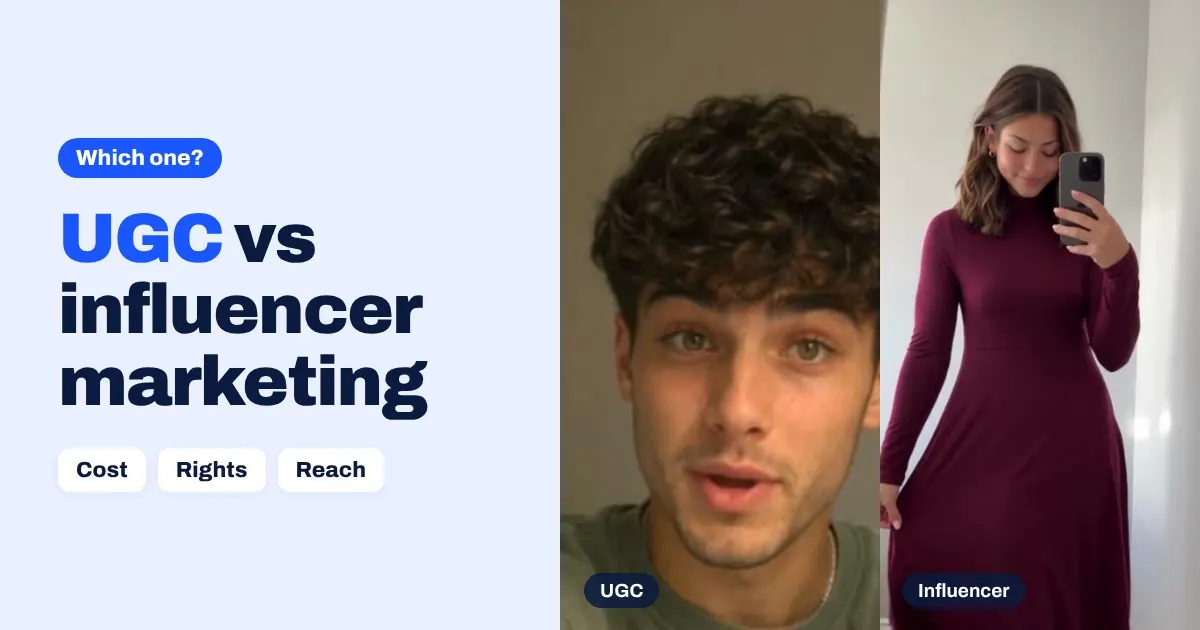
UGC and influencer marketing both use real-looking people on social media to sell products, so they get mixed up all the time. But they're different deals. With UGC, you're paying for content. With influencer marketing, you're paying for an audience.
Picking the wrong one is an expensive mistake. Brands pay influencer prices for videos they only run as ads, or pay for UGC and wonder why nobody new has heard of them. Here's how the two compare, what each one costs and how to choose.
The short answer
- UGC creators make videos for your brand to use, mostly as ads. The videos don't go on the creator's own feed. You run them from your own page.
- Influencers post about your brand to their own followers. You're paying for access to their audience and the trust they've built with it.
A simple way to think about it: a UGC creator is like hiring a video maker who looks like a customer. An influencer is like renting a billboard that people actually like.
UGC vs influencer marketing at a glance
| UGC creators | Influencers | |
|---|---|---|
| What you're buying | Videos and photos you can use | Reach to the creator's followers |
| Where it's posted | Your ads, your page, your website | The creator's own feed or stories |
| Who sees it | The people you target with ads | The creator's followers |
| Follower count needed | None | Matters a lot |
| Typical price | About $100 to $500 per video | From about $100 per post for small creators to $5,000+ for big ones |
| Usage rights | Usually included or sold with the video | Often extra if you want to run ads |
| Main goal | Sales and ad testing | Awareness and reach |
The price ranges come from a Backstage guide, which uses Collabstr marketplace data for UGC and common tier pricing for influencers (Backstage). Collabstr put the average cost of a UGC piece at about $197 in 2025. We break UGC prices down in more detail in how much a UGC video costs.
What UGC is good for
Testing ads at scale
UGC is built for paid ads. You can buy several videos, run them as ads to the exact people you want to reach, keep the winners and drop the losers. You're not limited to who follows the creator.
Cost per video
Because you're not paying for an audience, UGC usually costs less per video than an influencer post with similar production. That makes it easier to buy enough videos to test properly. We explain why volume matters in how many ad creatives to test.
Owning what you paid for
With UGC, the deal is usually about using the content. Make sure your agreement says where and for how long you can use it, especially for paid ads.
Trust
People tend to trust content from other customers more than polished brand ads. In surveys cited by EMARKETER, 60% of consumers called UGC the most genuine form of advertising, and 70% of Gen Z said it's very helpful when they're deciding what to buy (EMARKETER).
What influencer marketing is good for
Reaching new people
An influencer puts your product in front of an audience that already listens to them. For a new brand nobody knows, that can be the fastest way to get noticed.
Borrowed trust
When a creator people follow recommends something, it lands differently from an ad. Smaller creators often have the closest relationship with their followers. HypeAuditor's 2025 report found nano-influencers on TikTok had the highest average engagement rate of any tier, at about 10% (Backstage).
Content that keeps working
Influencer posts can bring in sales long after they go up, and a good one can become a strong ad too, if you agree on ad rights. On Meta and TikTok, you can run ads from the creator's own account with their permission. We explain how in Meta partnership ads and TikTok Spark Ads.
The downsides of each
UGC
- No built-in audience. Someone has to pay for ads, or nobody sees the video.
- You need a plan. You have to brief the creator, test the videos and keep making new ones as old ones wear out.
- Quality varies. Some creators are great at ads. Others make nice videos that don't sell.
Influencer marketing
- You can't control who sees it. The audience is whoever follows the creator, and it may not match your customers.
- Results are harder to measure. Links and codes help, but plenty of people see a post and buy later without them.
- Fake followers and low trust. Research published in Harvard Business Review found nearly half of consumers believe most influencers are fake (Backstage). Check a creator's engagement and comments, not just their follower count.
- Rights cost extra. Want to run their post as an ad? That's usually a separate fee.
Want UGC ads to test without hiring creators? Send us your product link and we'll make your first UGC ad free.
Which one should you choose?
Choose UGC if:
- You already run, or plan to run, paid ads on Meta or TikTok.
- You want to test lots of angles and hooks to find what sells.
- You care most about sales and cost per purchase.
- You need fresh ads every week or two.
Choose influencer marketing if:
- Nobody has heard of your brand yet and you need awareness.
- Your product suits a specific community, like gym-goers, new parents or gamers, with clear creators in it.
- You want people talking about your brand, not just seeing ads.
Or use both
Many brands do both. A simple way to do it:
- Use UGC to find what sells. Test angles and hooks with UGC ads, including AI UGC for speed.
- Use influencers to reach new people with the messages you've already proven.
- Turn the best influencer posts into ads with the creator's permission, and keep testing UGC alongside them.
Rules for both
Whichever you choose, the same honesty rules apply:
- Disclose paid relationships. In the US, the FTC says influencers have to clearly disclose any paid or free-product relationship with a brand, and in a video the disclosure should be in the video itself (FTC).
- No claims they can't back up. Creators shouldn't talk about products they haven't tried or make claims, like health benefits, that need proof they don't have (also from the FTC guide above).
- No fake reviews. The FTC bans fake reviews and testimonials (FTC).
FAQ
Is a UGC creator an influencer?
Not usually. A UGC creator makes content for brands to post. An influencer posts to their own followers. Some people do both, but they're different jobs with different prices.
Which is cheaper, UGC or influencers?
Per video, UGC is usually cheaper because you're not paying for an audience. But UGC needs ad spend to be seen, so count that in too.
Do UGC creators post the video on their own account?
Usually not. The brand runs the video from its own page or ad account. If you also want the creator to post it, agree on that and pay for it separately.
Can AI replace UGC creators or influencers?
AI can make UGC-style ads quickly and cheaply, which is great for testing. It can't replace an influencer, because an influencer's value is their real audience. We compare AI and real creators in AI UGC vs real creators.
What should I ask a creator before hiring them?
Ask for examples of ads they've made, what's included in the price, how long you can use the video and where. Our guide to writing a UGC creator brief walks through what to send them.
If you need UGC ads to test, UGC Beast writes the scripts, makes the videos and sends them ready to run, with your first video free.