Meta Partnership Ads and TikTok Spark Ads, Explained
What Meta partnership ads and TikTok Spark Ads are, how creator ad codes work, what the data says about results and when to use them instead of normal ads.
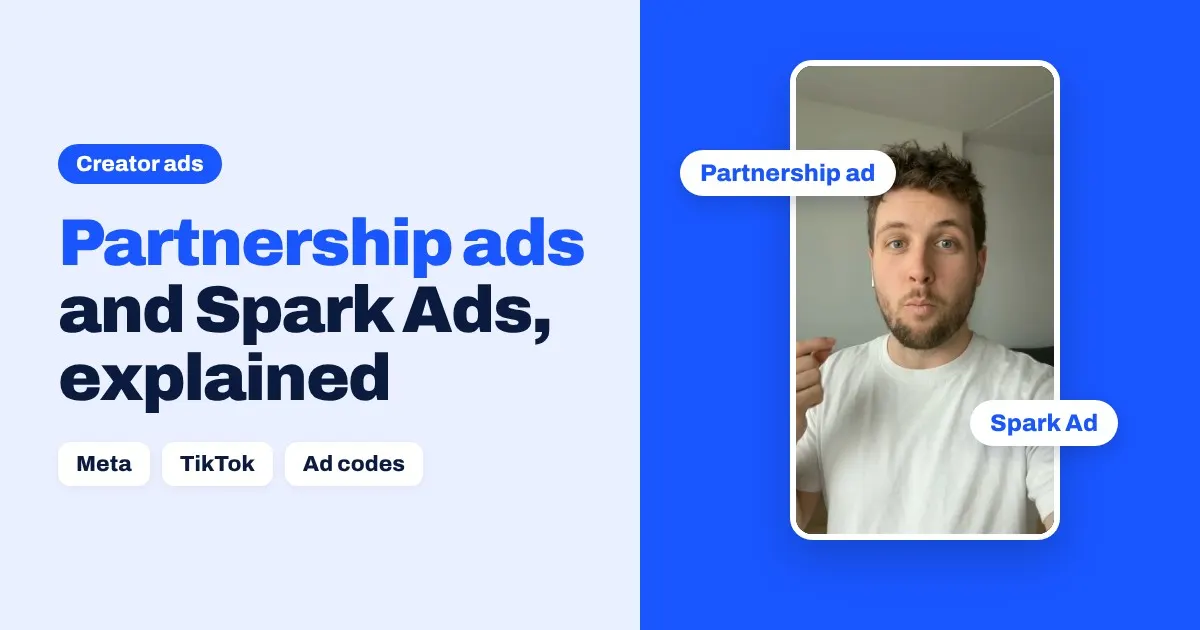
Most UGC ads run from the brand's own page. The video looks like a creator made it, but the name at the top says your brand. Meta partnership ads and TikTok Spark Ads change that. They let you run an ad from a creator's account, with their name and profile picture on it, while you control the budget and targeting.
You'll also hear this called whitelisting. Here's how each one works, what the data says about results, how to set them up and when they're worth it.
What partnership ads and Spark Ads are
Meta partnership ads
Partnership ads let brands run Facebook and Instagram ads "from a creator or other partner's handle" (Meta for Developers). The creator makes the content, the brand puts money behind it, and the ad shows the creator's handle. You may still hear the old name, branded content ads.
TikTok Spark Ads
Spark Ads let advertisers use organic TikTok posts and their features in ads (TikTok). The post can come from your brand's own account or from a creator who authorises it. People can like, comment, share, follow the account and even reuse the sound, just like a normal TikTok (TikTok).
Whitelisting
Whitelisting is the older, informal name for the same idea: a creator gives a brand permission to run ads through their account. Today the platforms handle it with ad codes and permissions inside their own tools, so you don't need the creator's login.
Why brands use them: what the data says
The main reason is trust. An ad from a real person's account looks and feels like a post from someone people follow, not an ad from a company.
The numbers back it up, with some caveats:
- Meta's own data says partnership ads average 19% lower cost per acquisition and 13% higher click-through rates than standard formats (EMARKETER).
- An August 2026 study by Agentio looked at about $130 million in spend across 65,000 ads and 137 brands. Partnership ads had a 19% higher click-through rate, a 10% higher conversion rate and a 5% lower cost per acquisition than the same kind of UGC run from brand accounts. They also cost 19% more per thousand views, and in Stories the cost per acquisition was 25% higher (Net Influencer).
- TikTok says Spark Ads had a 134% higher completion rate and a 157% higher six-second view rate than standard in-feed ads in a 2022 internal test (TikTok).
Keep in mind that Meta and TikTok sell these ads, and Agentio is a creator marketing company. The results are promising, but your own tests are what count. Note too that the Agentio study found partnership ads did better on average, not in every placement.
How to set up Meta partnership ads
There are two ways a creator can give you permission (Instagram for Creators):
- Ad codes, for one-off deals. The creator generates a partnership ad code for a specific post and sends it to you. You use the code in Ads Manager to turn that post into an ad.
- Account-level permission, for longer partnerships. The creator gives your brand permission to make ads from content they send you or from any post where they've tagged you.
Then, in Ads Manager:
- Create a campaign and ad set as normal.
- At the ad level, turn on partnership ads and choose the creator as your partner.
- Pick the post, or enter the ad code the creator sent.
- Set your budget, targeting and dates, then publish.
The creator stays in control. In their settings, they can see every active and inactive partnership ad and stop a brand from using their content (Instagram for Creators).
How to set up TikTok Spark Ads
The most common way is with a creator's authorisation code (TikTok):
- The creator makes the code. In the TikTok app, they open the video, tap the three dots, go to ad settings and tap "Generate" to get the post code.
- They send it to you, along with the length of time you're allowed to run it.
- You add it in Ads Manager. You can authorise up to 20 video codes at once.
- Build the ad with the creator's account as the identity, then add your link and call to action.
A few rules to know before you start:
- You can't edit a post's caption after it has been authorised as an ad.
- If the video was private, it becomes public once it's used in a campaign.
- A video code can only be deleted once every ad using it has been deleted.
All three come from TikTok's guide above. Agree on the caption with the creator before they generate the code.
Need ads to test before you spend on creator deals? Send us your product link and we'll make your first UGC ad free.
What to agree with the creator first
Running ads from someone else's account is a bigger ask than buying a video. Put these points in writing before you start:
- How long you can run it. 30, 60 or 90 days are common. Longer usage usually costs more.
- Where you can run it. Meta only, TikTok only or both.
- What you can change. Can you add captions, cut a shorter version or swap the call to action?
- The price. Most creators charge extra for running ads from their account, on top of the video fee. We cover typical fees in how much a UGC video costs.
- Comments. Who replies to comments on the ad, and how quickly.
- Disclosure. The ad has to be clearly marked as paid. The platforms label partnership ads and Spark Ads, and in the US the FTC expects any paid relationship to be clear to viewers (FTC).
When to use them, and when not to
Use partnership ads or Spark Ads when:
- You already have a winning UGC video from a real creator and want to squeeze more out of it.
- The creator has a real audience that matches your customers. Their followers may recognise them, which adds trust.
- You're running retargeting or prospecting in Feed and Reels, where the data looks strongest.
Stick with normal ads from your page when:
- You're still testing angles and hooks. You need many versions fast, and getting a code for every test slows you down. We explain how many to test in how many ad creatives to test.
- The creator doesn't want their name on ads, or the price for using their account doesn't make sense.
- The video was made with AI. An AI creator doesn't have a real account, so these ads have to run from your brand page. That's normal and fine.
Use both
A simple way to work: test lots of angles and hooks with ads from your own page, including AI UGC, which is quick and cheap to make. When you find a winner, bring in a real creator to remake it and run it as a partnership ad or Spark Ad. You get fast testing and the trust of a real account. We compare the two kinds of creators in AI UGC vs real creators.
Common mistakes
- Not agreeing on usage in writing. "You can use it" isn't enough. Write down the platforms, the length of time and the price.
- Letting codes expire mid-campaign. Check expiry dates so a winning ad doesn't suddenly stop.
- Ignoring comments. Comments land on the creator's post. Agree who handles questions so customers don't go unanswered.
- Judging too fast. Partnership ads can cost more per view. Judge them on cost per purchase or lead, not cost per thousand views.
FAQ
Are partnership ads the same as whitelisting?
Mostly, yes. Whitelisting is the old informal name. Partnership ads are Meta's official way of running ads from a creator's account, with permission handled by codes or account settings.
Do I need the creator's password?
No. Meta uses ad codes and account permissions, and TikTok uses authorisation codes. You should never need a creator's login.
How much extra do creators charge?
It varies a lot by creator and by how long you run the ad. Expect to pay more for longer periods and for running on more than one platform.
Can I run AI UGC as a partnership ad?
No. Partnership ads and Spark Ads have to come from a real account that agrees to it. AI UGC runs from your brand's own page.
Do partnership ads always beat normal ads?
No. Studies show better results on average, but not in every placement or for every brand. Test them against your normal ads.
Partnership ads and Spark Ads are a strong way to get more from a winning creator video. If you need ads to test first, UGC Beast writes the scripts and makes the videos, and your first one is free.