Meta Andromeda: What It Means for Your Ad Creatives
What Meta Andromeda is, what Meta has said about it, why creative diversification now matters more than targeting, and how many different ads you should run.
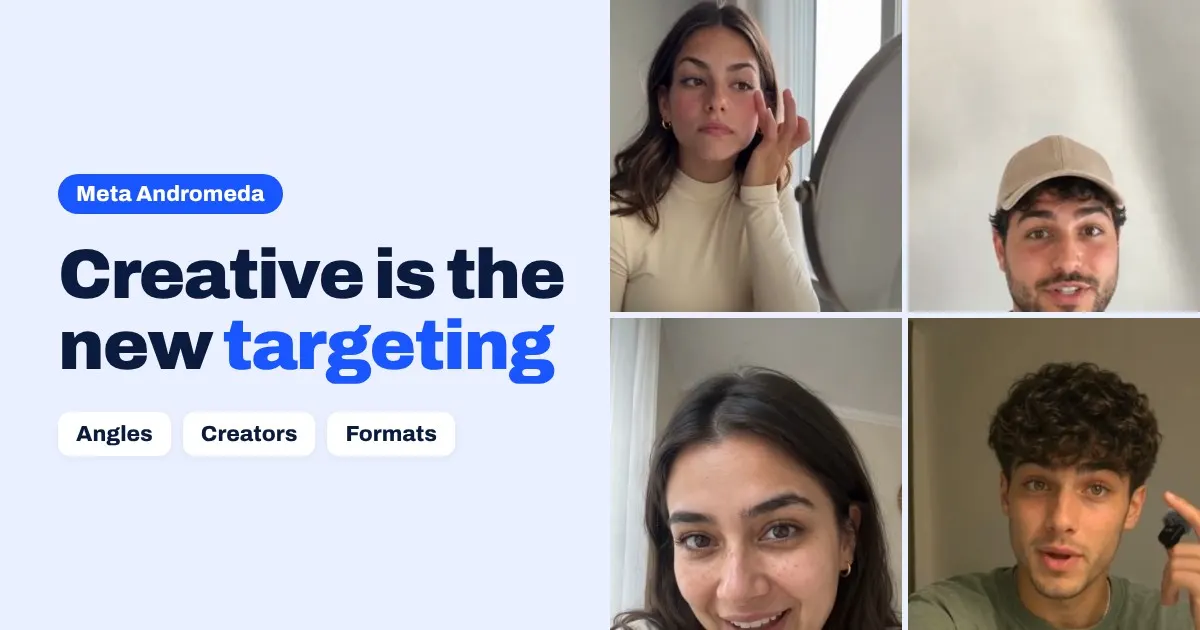
If you run Facebook or Instagram ads, you've probably heard "creative is the new targeting" a lot this year. A big reason is Andromeda, the system Meta uses to pick which ads to consider showing each person.
You don't need to understand the engineering to use it well. What you need to know is what changed, what didn't, and what it means for the ads you make. This guide covers all three in plain English.
What Meta Andromeda is
Every time someone opens Facebook or Instagram, Meta has to decide which ad to show them out of millions. It does this in steps. Andromeda is the first step, called retrieval. Meta says it narrows "tens of millions" of possible ads down to "a few thousand" for each person, before other systems rank those and pick the winner (Meta Engineering).
Think of it as the shortlist. If your ad doesn't make Andromeda's shortlist for someone, it never gets a chance to be shown to them.
What Meta has said about it
Meta announced Andromeda in December 2024. In that first post, it reported a 6% improvement in recall (finding the right ads) and an 8% improvement in ad quality on selected segments (Meta Engineering).
In October 2026, Meta published an update on a newer version. It said the system now handles over one billion ads per second, 100 times more than the 2024 version, and that Andromeda has delivered a 2.4% increase in conversions on Facebook since 2025 (Meta Engineering).
These are Meta's own numbers. The bigger point is that Meta's system is now much better at matching each ad to the right person on its own.
Why it changes how you make ads
Andromeda looks closely at the ad itself, including the visuals, the words and who it seems to be for, to work out who should see it. That shifts a lot of the work that targeting used to do into the creative.
In the past, you might have run one ad to five carefully targeted audiences. Now the approach is closer to the opposite: one broad audience, and several different ads that each speak to a different kind of customer. Meta matches each person to the ad most likely to work on them.
Meta has said this directly. Its advice is to build a broad portfolio of text, image and video ads that reflect different customer personas, rather than making a fixed number of creatives per campaign (Social Media Today).
That's what people mean by creative diversification.
What "different" actually means
This is where most brands go wrong. Ten ads that are almost the same give the system one option, not ten. Changing the background colour, swapping one word in the headline or trimming a second off the video doesn't make a new ad.
Jon Loomer, who writes about Meta ads, says variations should be noticeably distinct in their visuals, formats, the personas and pain points they speak to, and their text (Jon Loomer). In practice, ads feel different when they change one or more of these:
| Change the… | Example |
|---|---|
| Angle | Saves time vs saves money vs looks better |
| Customer | Busy mum vs student vs gym-goer |
| Pain point | Mess vs cost vs embarrassment |
| Format | Talking head, demo, unboxing, voiceover over B-roll, static image, carousel |
| Creator | Different age, gender, setting and energy |
| Hook | Question vs bold claim vs result first |
| Proof | Testimonial vs demo vs before and after |
Meta has also started showing a Creative diversity column in Ads Manager, still marked as in development, that rates how visually varied your ads are as low, medium or high (Search Engine Land). It's early, but it shows where Meta is heading.
Need more variety in your ads? Send us your product link and we'll make your first UGC ad free, built around a new angle for your product.
How many ads should you run?
Meta used to suggest a limit of around six ads per ad set. That advice is gone, and many advertisers now run 10, 20 or more (Jon Loomer).
But more isn't automatically better. A January 2026 column in AdExchanger warns that loading 20 or more creatives into one ad set can hurt smaller brands, because their budgets can't give each ad enough data (AdExchanger).
A sensible way to think about it:
- Small budgets: a handful of truly different ads, maybe 3 to 6, each with its own angle.
- Bigger budgets: more concepts, because there's enough spend to test them properly.
- Always: each ad should add something the others don't.
We go deeper on this in how many ad creatives to test.
What hasn't changed
Andromeda is clever, but it isn't magic. As the AdExchanger column puts it, results still depend on your signals, your goals and the quality of your creative (AdExchanger). Some things matter as much as ever:
- A strong hook. Ads still need to stop the scroll in the first seconds. Track it with hook rate and hold rate.
- A clear offer. No system can make a weak offer sell.
- Good tracking. Your pixel and conversion events tell Meta who actually buys. Bad data means bad matching.
- A working website. The ad gets the click. Your page makes the sale.
How to set up your account for Andromeda
- Keep targeting broad. Let the creative do the targeting. Use detailed targeting sparingly.
- Simplify your structure. Fewer campaigns and ad sets, more ads inside them, so each ad set gets enough data.
- Plan ads by customer type. Write down three or four kinds of buyer and make at least one ad for each.
- Mix formats. Include video and images, and use 9:16 for Reels and Stories. See our Reels and TikTok ad specs.
- Add new concepts regularly. Andromeda can use up a creative quickly. Fresh ads every week or two help prevent ad fatigue.
- Make variations of winners too. When one concept works, give it new hooks and new creators to stretch its life.
Where UGC fits
UGC-style video is one of the easiest ways to get real variety. One product can have many different creators, each talking to a different kind of customer, with a different hook and angle. That's exactly the kind of range Andromeda rewards.
The catch has always been cost and time. Hiring a new creator for every persona adds up fast, as we show in how much a UGC video costs. AI UGC makes it practical to test many creators and angles quickly. We compare the two in AI UGC vs real creators.
Common mistakes
- Uploading near-duplicates. Ten ads with the same video and slightly different text count as one idea.
- Splitting into many small ad sets. It spreads your budget thin and starves each ad of data.
- Going too narrow on targeting. It fights against what the system is built to do.
- Adding 30 ads on a small budget. Most will never get enough spend to tell you anything.
- Never refreshing. Even the best ad set needs new concepts over time.
FAQ
What is Meta Andromeda in simple terms?
It's the system Meta uses to shortlist which ads to consider for each person, before picking which one to show. It works out who each ad suits by looking at the ad itself.
When did Andromeda launch?
Meta announced it in December 2024 and has kept improving it since, including a newer version described in October 2026.
Do I still need audience targeting?
Less than before. Most advertisers now keep targeting broad and use different ads to reach different kinds of customers.
How many ads should I put in one ad set?
There's no fixed number. Small budgets do well with a few truly different ads. Bigger budgets can test more. What matters is that each ad is meaningfully different.
Does Andromeda work on Instagram too?
Yes. It's part of Meta's ad system, which delivers ads across Facebook, Instagram and Meta's other placements.
Andromeda rewards brands that give it real choice: different angles, different customers, different creators. If you'd like that variety without managing shoots, UGC Beast researches your market, writes the scripts and makes the videos, and your first one is free.