Hook Rate and Hold Rate: How to Measure Your Video Ads
What hook rate and hold rate are, the formulas for Meta and TikTok, what a good hook rate looks like, how to set them up in Ads Manager and how to fix low numbers.
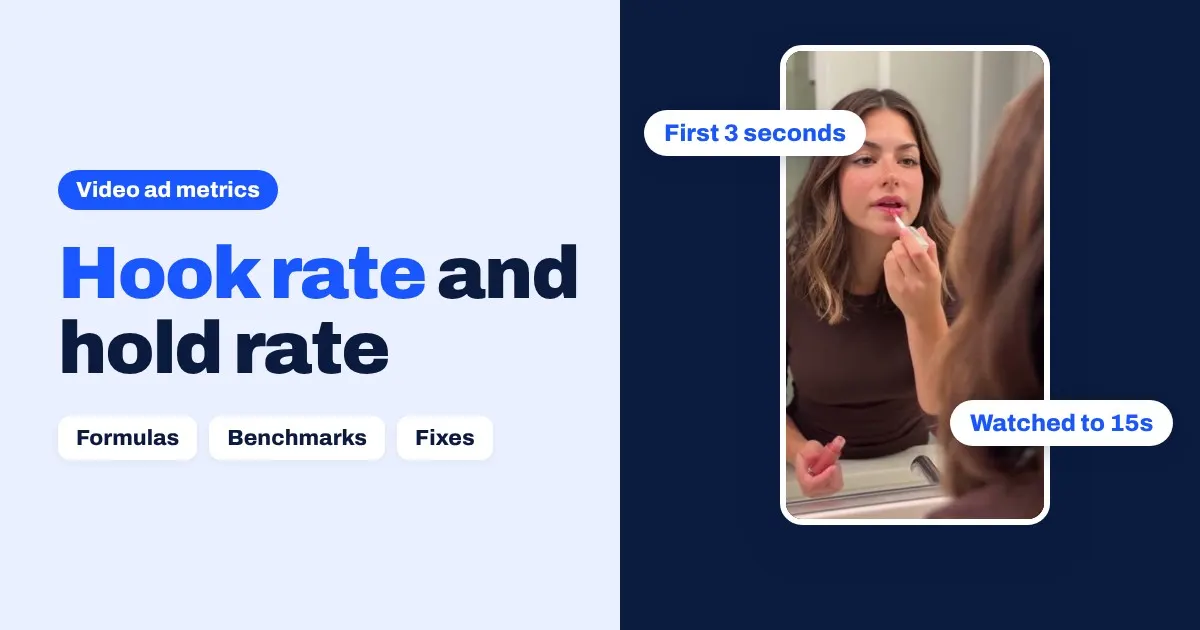
Most video ads lose people in the first few seconds. If nobody stops scrolling, it doesn't matter how good the rest of the video is. And if people stop but leave after five seconds, they never hear your offer.
Two numbers tell you exactly where an ad is losing people: hook rate and hold rate. Neither is a default column in Meta Ads Manager, but both take a couple of minutes to set up. This guide explains what they mean, how to calculate them, what good looks like and what to do when they're low.
What hook rate and hold rate are
- Hook rate tells you how many people stopped scrolling to watch the start of your video. It measures your opening.
- Hold rate tells you how many of those people kept watching. It measures everything after the opening.
Together they show you which part of an ad needs work. A low hook rate means fix the first three seconds. A good hook rate with a low hold rate means people stopped, then got bored.
You might also see hook rate called "thumbstop ratio". It's the same idea.
How to calculate them on Meta
Meta reports the numbers you need, you just have to divide them. The common formulas, as set out by Billo (Billo), are:
| Metric | Formula |
|---|---|
| Hook rate | 3-second video plays ÷ impressions × 100 |
| Hold rate | ThruPlays ÷ 3-second video plays × 100 |
A ThruPlay counts when someone watches your video to the end, or for at least 15 seconds, whichever comes first.
A quick example
Say your ad got 10,000 impressions, 2,800 three-second plays and 700 ThruPlays.
- Hook rate = 2,800 ÷ 10,000 × 100 = 28%
- Hold rate = 700 ÷ 2,800 × 100 = 25%
So 28% of people stopped to watch, and a quarter of those watched to the end or for 15 seconds.
A note on the new 6-second ThruPlay
In November 2026, advertisers spotted a new option in Ads Manager to count a ThruPlay at 6 seconds instead of 15, for Awareness and Engagement campaigns (PPC Land). The default is still 15 seconds. If you change the setting, your hold rate numbers won't compare with older ads, so keep it the same across the ads you're comparing.
How to calculate them on TikTok
TikTok uses different view lengths. The usual versions are:
| Metric | TikTok formula |
|---|---|
| Hook rate | 2-second video views ÷ impressions × 100 |
| Hold rate | 6-second video views ÷ 2-second video views × 100 |
TikTok's free Top Ads tool also lets you sort other brands' ads by 2-second and 6-second view rate, which is a good way to study strong hooks. See how to use TikTok Top Ads.
What is a good hook rate?
It depends on your industry, product and audience, so your own account is the best benchmark. But it helps to know roughly where you stand.
Billo looked at 88,329 sales-objective Meta video ads in the first half of 2026. The average hook rate was 25.44%, and no industry averaged above 29% (Billo). Based on that data:
| Hook rate | What it means |
|---|---|
| Below 21% | Weak. Under every industry average in that data |
| Around 25% | Average |
| 30% or more | Strong. Keep this hook and build on it |
For hold rate, there's no widely published benchmark. The simplest approach is to compare each ad with the median of your own ads. Anything well below your median needs work after the hook.
How to add them as columns in Ads Manager
You don't need a spreadsheet. Meta lets you create custom metrics that show up as columns.
- In Ads Manager, open the Columns menu and choose Customize columns.
- Click Create custom metric.
- Name it "Hook rate". Build the formula: 3-second video plays divided by Impressions. Set the format to percentage.
- Save, then create a second one called "Hold rate": ThruPlays divided by 3-second video plays, as a percentage.
- Add both to a saved column preset, along with CTR, cost per result and frequency.
Jon Loomer has a detailed walkthrough of custom metrics if you want to go further (Jon Loomer).
Check the numbers at the ad level, not the ad set level. You want to compare one creative with another.
Low hook rate? Send us your product link and we'll make your first UGC ad free, with an opening built to stop the scroll.
How to read the results
Put the two numbers side by side and the problem usually becomes clear.
| Hook rate | Hold rate | What's going on | Fix |
|---|---|---|---|
| Low | Low | The ad isn't working yet | New hook and a tighter script |
| Low | High | The few who stop love it | Keep the body, test new openings |
| High | Low | People stop, then leave | Fix the pacing after the hook |
| High | High | It's working | Make more versions of it |
Then check the result that matters: cost per purchase or lead. A high hook rate on an ad that doesn't sell might mean the opening is clickbait that attracts the wrong people. The best hooks stop the right person, not everyone.
How to improve a low hook rate
The first one to three seconds decide everything. Meta itself says the first few seconds determine whether viewers keep watching Reels, and suggests leading with the viewer's benefit, saying upfront what they'll see, or opening with a question (Social Media Today).
Things to try:
- Start mid-action. Open with the product already doing something, not a slow intro.
- Say the problem in the first line. "My hair was falling out in the shower" beats "Hey guys".
- Put text on screen that matches the spoken hook, for people watching on mute.
- Show a result first, then explain how you got there.
- Use a face. A person talking to camera often stops the scroll better than a product shot.
- Test several openings on the same video. Our UGC ad hooks list gives you 40 to start with.
How to improve a low hold rate
If people stop but don't stay, the problem is what comes after the hook.
- Cut the warm-up. Get to the point within a few seconds of the hook.
- Change something every two or three seconds: a new shot, angle, caption or demo moment.
- Show, don't just tell. A demo holds attention better than someone describing the product.
- Make it shorter. If most people leave at 12 seconds, try a 15-second version.
- Keep the promise from the hook. If the hook asks a question, answer it. Don't make people wait to the end.
Our guide to writing a UGC ad script shows a simple structure that keeps people watching.
Watch for hook rate falling over time
A hook that worked last month can wear out. If an ad's hook rate slowly drops while frequency rises, people have seen it too many times. That's a sign of ad fatigue, and a new opening is often the quickest fix.
Common mistakes
- Judging too early. Wait for a few thousand impressions before deciding an ad's hook rate is good or bad.
- Chasing hook rate alone. A shocking opening that has nothing to do with the product gets views, not sales.
- Comparing different setups. Hook rates differ by placement, audience and objective. Compare like with like.
- Changing the ThruPlay setting mid-test. It changes hold rate and makes old and new ads impossible to compare.
- Fixing the wrong part. A great body can't save a weak hook, and a great hook can't save a boring body. Fix the part the numbers point to.
FAQ
What is a good hook rate for Facebook ads?
Around 25% is average for sales-focused Meta video ads, based on Billo's 2026 data. Above 30% is strong. Below about 21% means your opening needs work.
Is hook rate the same as thumbstop ratio?
Yes. Both measure the share of people who watched the first three seconds of your video out of everyone who saw it.
Why isn't hook rate in Ads Manager by default?
Meta shows the raw numbers, like 3-second video plays and impressions, but not the ratio. You can add it in a minute as a custom metric.
Which matters more, hook rate or hold rate?
Hook rate comes first, because nobody can be held if they never stop. But the number that matters most is still cost per purchase or lead.
Do static image ads have a hook rate?
No. Hook rate and hold rate are video metrics. For images, CTR is the closest measure of whether the ad grabs attention.
Hook rate and hold rate turn "this ad isn't working" into "this part of the ad isn't working", which is much easier to fix. If you'd like ads built with strong openings from the start, UGC Beast writes the scripts and makes the videos, and your first one is free.