How to Write a UGC Ad Script (Free Template)
A simple 5-part UGC ad script template, word counts for 15, 30 and 45 second ads, three example scripts and the mistakes that make UGC ads flop.
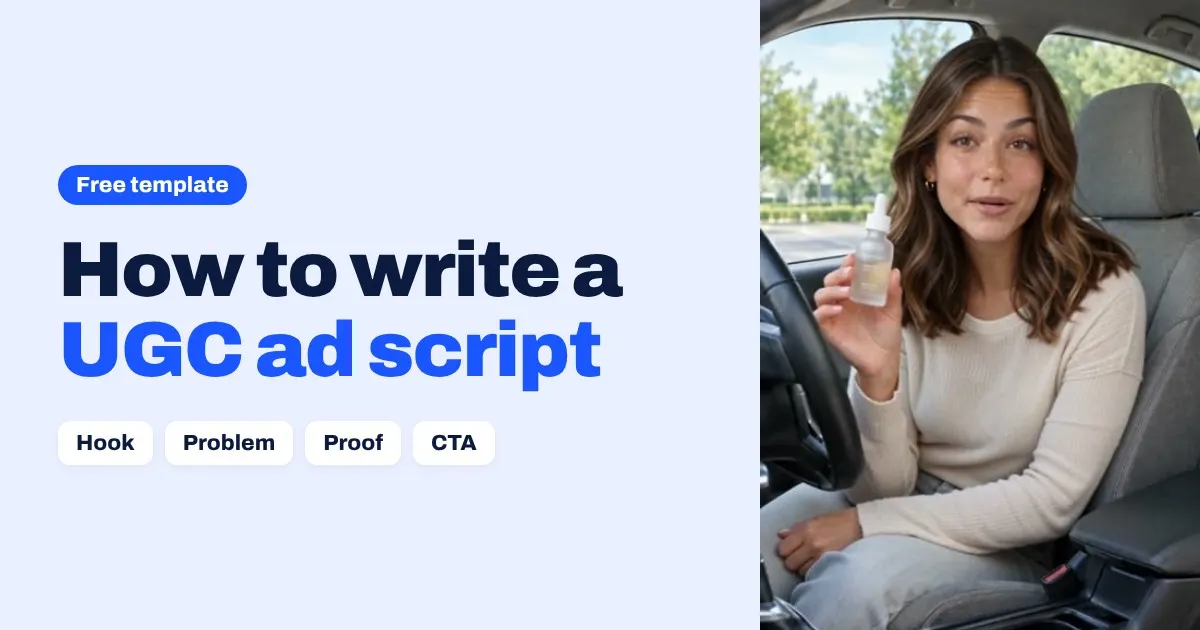
A good UGC ad looks like someone just picked up their phone and talked about a product they like. It almost never happens that way. Behind most UGC ads that sell is a script that was planned line by line, even if it doesn't sound like it.
This guide gives you a simple five-part script template, how many words to write for each ad length, three example scripts you can copy the shape of and the mistakes that make UGC ads flop.
What makes a UGC script different
A normal ad script sounds like a brand talking. A UGC script sounds like a person talking. That changes how you write it:
- Write how people speak. Short sentences. Contractions like "I'm" and "it's". Words your customer would use, not words from your website.
- One person, one story. The creator is a customer telling a friend about something that helped them, not a presenter reading features.
- Show, then say. Every line should have something to look at: the product, the problem or the result.
- Built for the feed. Vertical video, captions on and a hook in the first few seconds.
Meta's research backs up the "show it" part. In a study Meta shared with Toluna, direct response ads that showed the product more than once were 2.7 times more likely to rank in the top 20% for purchase intent, and ads that explained USPs or features were 5.3 times more likely (Social Media Today).
The 5-part UGC ad script template
Most UGC ads that sell follow the same order. Here's the template we start every script with.
| Part | What it does | Length in a 30-second ad |
|---|---|---|
| 1. Hook | Stops the scroll | 0 to 3 seconds |
| 2. Problem | Shows a pain the viewer knows | 3 to 8 seconds |
| 3. Product | Introduces your product as the fix | 8 to 15 seconds |
| 4. Proof | Shows why it works or why people trust it | 15 to 25 seconds |
| 5. Call to action | Tells people what to do next | 25 to 30 seconds |
1. Hook
The first line and first shot. Its only job is to make someone stop and keep watching. Open with a problem, a question, a bold statement or the product doing something visual. We list 40 hooks you can adapt in our guide to UGC ad hooks.
2. Problem
Name the pain your customer already feels, in their words. Be specific. "My skin is dry" is weak. "My foundation looks patchy by lunch" is something people recognise straight away.
3. Product
Bring in the product as the answer to that problem. Get it in the creator's hand and on screen. Say what it is and the one thing that makes it different.
4. Proof
Give people a reason to believe you. That could be a quick demo, a close-up of the result, the number of reviews, an ingredient that explains how it works, a guarantee or a comparison with the old way. Only use proof that's true and that you can back up.
5. Call to action
Tell people exactly what to do: "Tap the link to try it", "Grab yours before the sale ends" or "Get it with free shipping". Meta's research found a visual or spoken call to action made ads 1.9 times more likely to rank in the top 20% for purchase intent (Social Media Today). Say it and show it on screen.
How many words to write
Most people speak at about 2.5 words a second in a natural, upbeat UGC style. That gives you a simple rule:
| Ad length | Spoken words | Best for |
|---|---|---|
| 15 seconds | 30 to 40 words | Simple products, one clear benefit, retargeting |
| 30 seconds | 65 to 80 words | Most products, the default length |
| 45 seconds | 100 to 115 words | Products that need explaining, apps, higher prices |
If your script runs long, cut words before you speed up the creator. A rushed read sounds like an ad. Back in 2017, Facebook advised keeping mobile video ads to 15 seconds or less and getting the brand message in early (Marketing Dive). Longer UGC ads can work well today, but every extra second has to earn its place.
The script template, ready to fill in
Copy this into a doc and fill in the brackets.
| Part | Spoken line | What's on screen | Caption |
|---|---|---|---|
| Hook | "[Problem or bold line]" | [Creator, product or problem in the first frame] | [3 to 5 words] |
| Problem | "I used to [problem], and [how it felt]." | [The problem in real life] | [Short version of the problem] |
| Product | "Then I found [product]. It [main benefit]." | [Product in hand, label to camera] | [Product name] |
| Proof | "[Demo, result, review or reason it works]." | [Close-up or demo] | [Key proof point] |
| Call to action | "[What to do], [reason to do it now]." | [Product plus a pointing gesture or link] | [Offer or "Shop now"] |
Write a few hooks for every script. The body stays the same and only the first line changes. That way one script becomes three to five ads you can test.
Don't want to write scripts yourself? Send us your product link. We write the script and hooks, you approve them, and your first ad is free.
3 example UGC ad scripts
These are for made-up products, so you can see the shape without copying anyone's ad.
Example 1: Lip gloss (15 seconds, 34 words)
- Hook: "Sticky lip gloss? Watch this."
- Problem: "Every gloss I tried glued my hair to my face."
- Product: "This one feels like nothing. Still shiny."
- Proof: "Windy day test, look. Nothing sticks."
- Call to action: "Tap below and grab your shade."
The creator holds the tube from the first frame. The windy day test is the proof, and it's something people can see.
Example 2: Dog chew toy (30 seconds, 72 words)
- Hook: "My dog destroys every toy in five minutes. Except this one."
- Problem: "I was spending forty dollars a month on toys that ended up in the bin."
- Product: "This chew is made from tough natural rubber, and you can fill the middle with treats."
- Proof: "We're on week six. Look at it. Barely a scratch, and he still goes crazy for it."
- Call to action: "If your dog eats toys for breakfast, tap the link and try one."
The proof is the toy itself after six weeks. Only use a claim like this if it's true for your product.
Example 3: Budgeting app (45 seconds, 100 words)
- Hook: "I used to check my bank app and feel sick. Here's what changed."
- Problem: "I never knew where my money went. Coffee here, a subscription there, and by the end of the month there was nothing left. I tried spreadsheets and gave up after a week."
- Product: "Then I tried this app. You connect your account once and it sorts every payment for you."
- Proof: "This screen shows exactly what I spend on food, bills and fun. It even found two subscriptions I forgot I had."
- Call to action: "It's free to start. Tap the link, connect your account and see where your money really goes."
For apps, the screen is the product. Cut to a screen recording while the creator talks, then back to their face.
Rules to follow in every script
- Only say what's true. Every claim, result and number needs to be something you can prove. Meta and TikTok both reject ads with misleading claims.
- Keep endorsements honest. The FTC's Endorsement Guides say endorsements must reflect the honest opinions and experiences of the endorser, and an endorser who says they use a product has to be a real user (Federal Register).
- No fake reviews. The FTC bans fake reviews and testimonials, including ones that misrepresent who wrote them (FTC).
- Be careful with health and money claims. Skincare, supplements, weight loss and finance products have extra rules on both platforms. When in doubt, describe the experience, not a medical or financial result.
- Don't fake a doctor or expert. Never put a creator in a white coat to recommend a health product unless they really are that professional.
If you use AI creators, the same rules apply, plus the platforms' rules on AI content. We cover those in AI UGC vs real creators.
Common UGC script mistakes
- Opening with a hello. "Hey guys, so today..." wastes the most valuable seconds of the ad.
- Listing features. Five features in a row sounds like a product page. Pick the one benefit that matters most and show it.
- Writing like a brand. "Our innovative formula delivers..." is not how anyone talks to a friend.
- No proof. A claim with nothing to see behind it is easy to scroll past.
- A weak ending. If you don't tell people what to do, most of them won't do anything.
- Only one hook. Write three to five openings for every script. It's the cheapest test you can run.
FAQ
How long should a UGC ad script be?
For a 30-second ad, about 65 to 80 spoken words. For 15 seconds, 30 to 40 words. Cut words rather than rushing the read.
Should the creator read the script word for word?
The meaning should stay the same, but small changes that make it sound natural are fine. A script that sounds read loses the trust that makes UGC work.
Do I need a different script for TikTok and Meta?
Usually not. The same script works on both, but TikTok viewers tend to respond to a more casual, creator-led tone. Test the same script with different hooks on each.
How many scripts should I write?
Start with two different angles, each with three to five hooks. That gives you six to ten ads to test. See how many ad creatives to test for more on this.
What does a UGC script cost if I hire someone?
Many creators include the script in their price, while others charge extra for it. We break down the numbers in how much a UGC video costs.
Use the template, write three hooks and test them. Or let us handle it: UGC Beast writes the script, you approve it, and we make the ad, with your first video free.